AURORA — personal agentic operating system
A personal AI assistant and local platform for managing and orchestrating a team of AI agents.
Motivation
Claude Code is excellent for a single session on a single repository. I run several projects in parallel, along with my personal agenda and my household. What I was missing was one assistant that could handle all of it: a single chat that knows the context (I get a morning briefing from my vault), hands work off to the right team on its own so I don't have to steer agents manually, and can control my smart home too. With the agents themselves, I kept running into four limits:
Agents aren't persistent. A Claude Code subagent has a role and tools, but every run starts from scratch and only knows what it managed to write down last time. Agent teams are experimental and disappear when the session ends.
Multi-agent tools manage sessions, not teams. Conductor and Claude Squad run parallel sessions in worktrees. OpenClaw and Paperclip offer teams with a lead. But Paperclip only ever shows one conversation with an agent, and only within a single company.
Off-the-shelf solutions didn't fit. OpenClaw comes closest in features, but it doesn't give each agent its own MCP servers, doesn't check learned changes against past tasks, and responses through the subscription took around 15 s.
Management lives in files and the terminal. In Claude Code, an agent is a Markdown file in
.claude/agents/, permissions and MCP servers are JSON insettings.json, and a team is created with a command inside a session. There's no graphical interface showing who is working on what across dozens of agents and projects, what is waiting for approval and how each agent is configured.
The goal: one personal assistant that runs persistent agents with roles and permissions in a single app, parallel work I can step into at any time, and responses within seconds.
What AURORA is
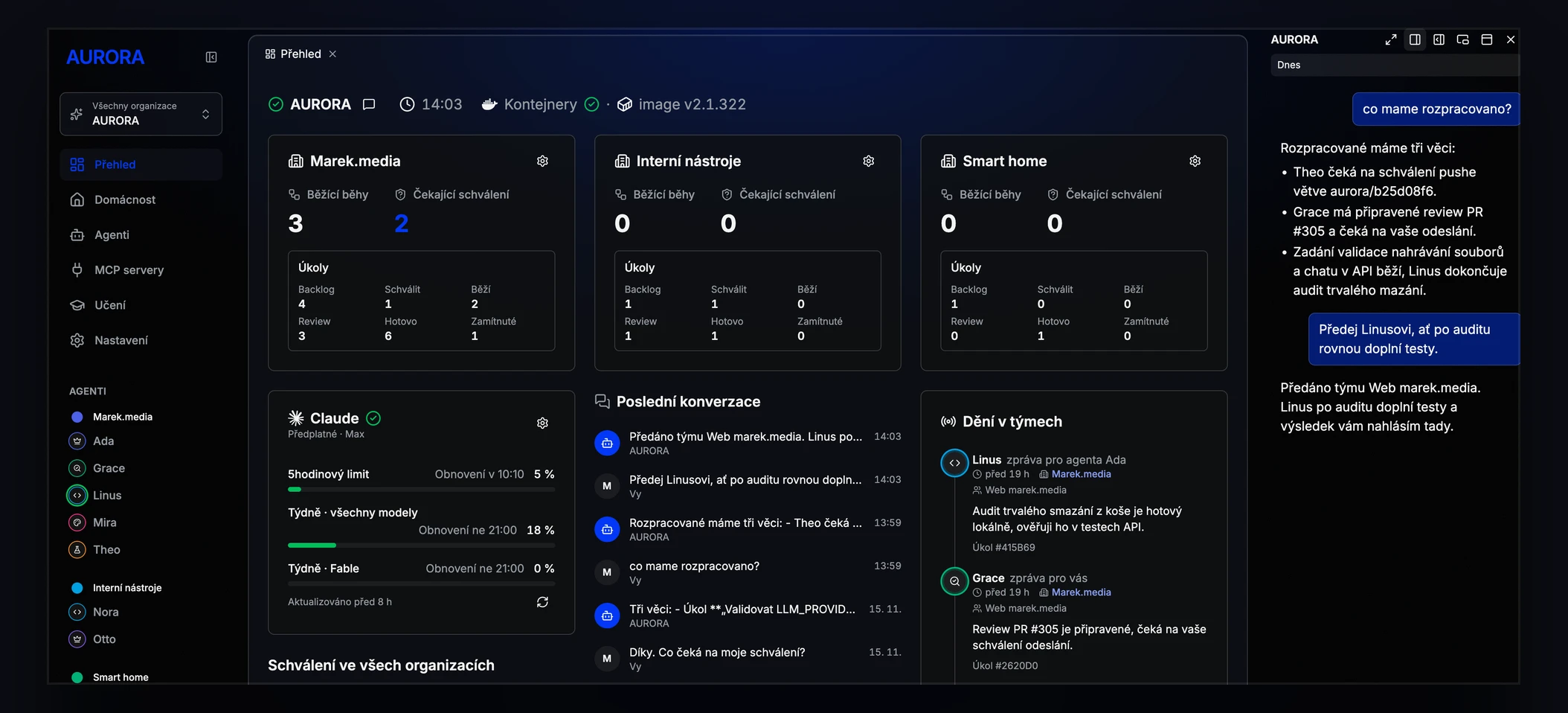
AURORA is a personal AI assistant and, at the same time, a local workspace for a team of persistent AI agents. I talk to the assistant in a chat: I get a morning briefing, it hands work off to teams and reports their results back to me, it controls my smart home and runs automations that react to events or run on a schedule (for example, a morning email digest or a review of every new pull request). The agents under it are entities with a role, a model, their own tools, permissions and their own long-running conversation, not one-off sessions.
None of AURORA's individual features is new; there are plenty of similar tools and AI agents out there. But none of them brings them all together.
What is new is combining them in a single local app with a graphical interface:
a personal assistant above the teams: one chat, a morning briefing from the vault, smart home control and handing work off to teams,
persistent agents with their own long-running conversations across projects,
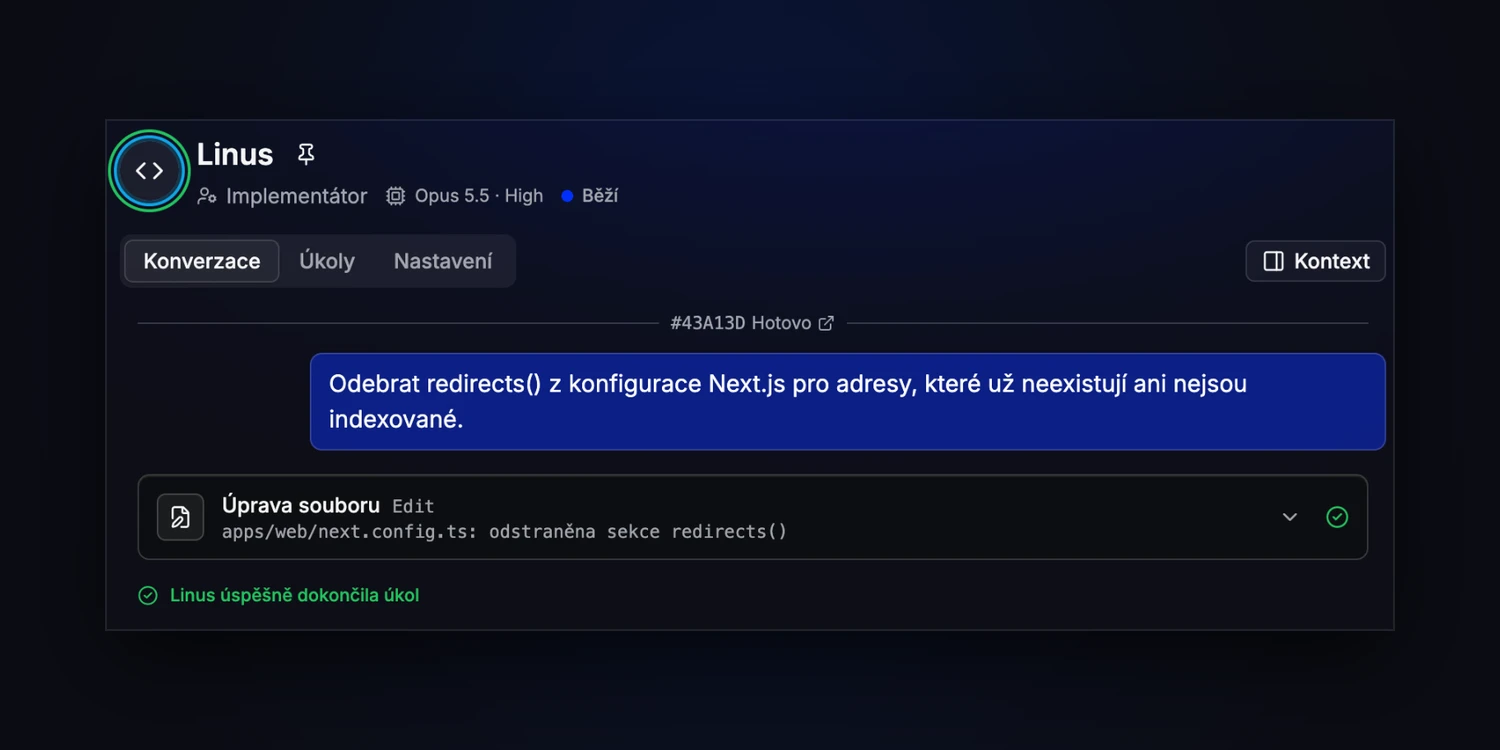
teams with a lead,
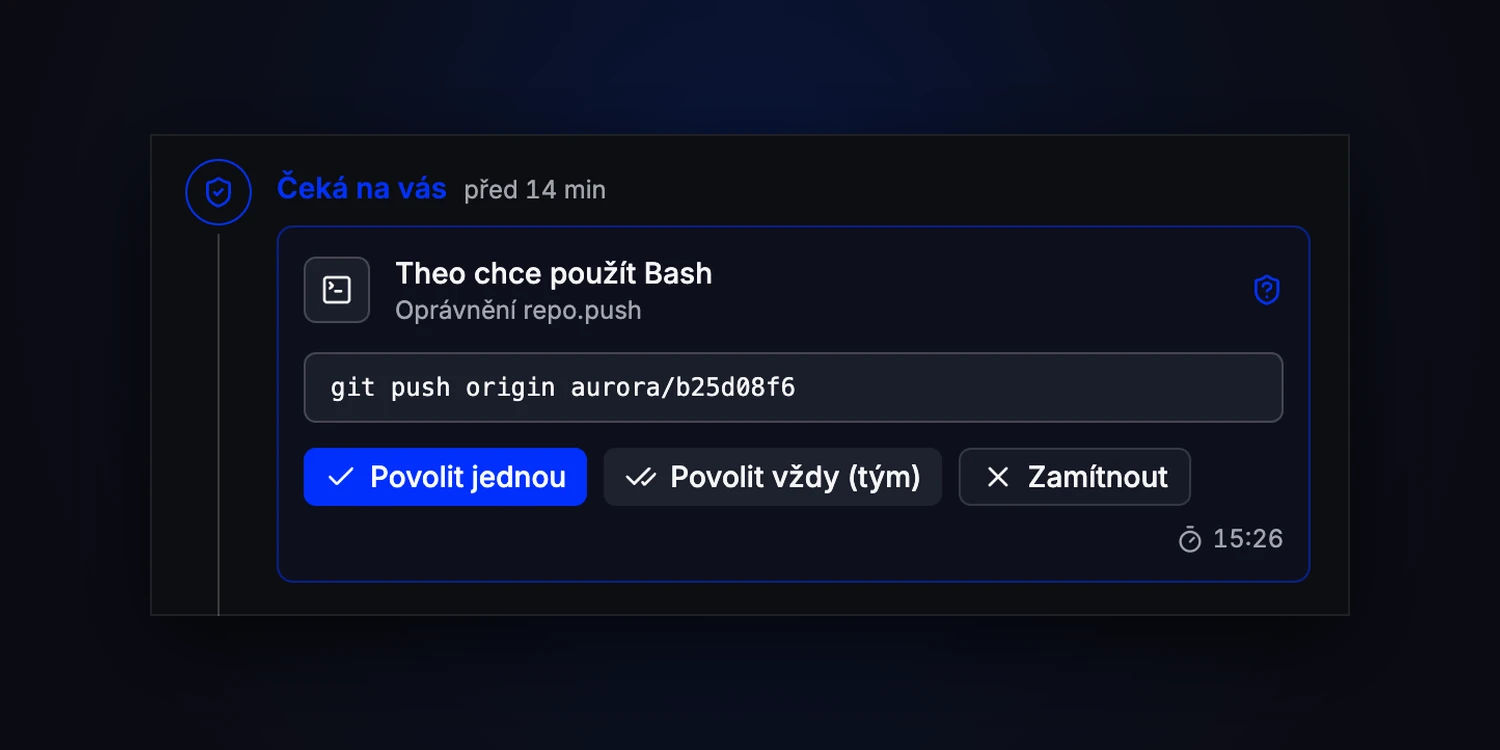
per-agent MCP servers and per-action approvals,
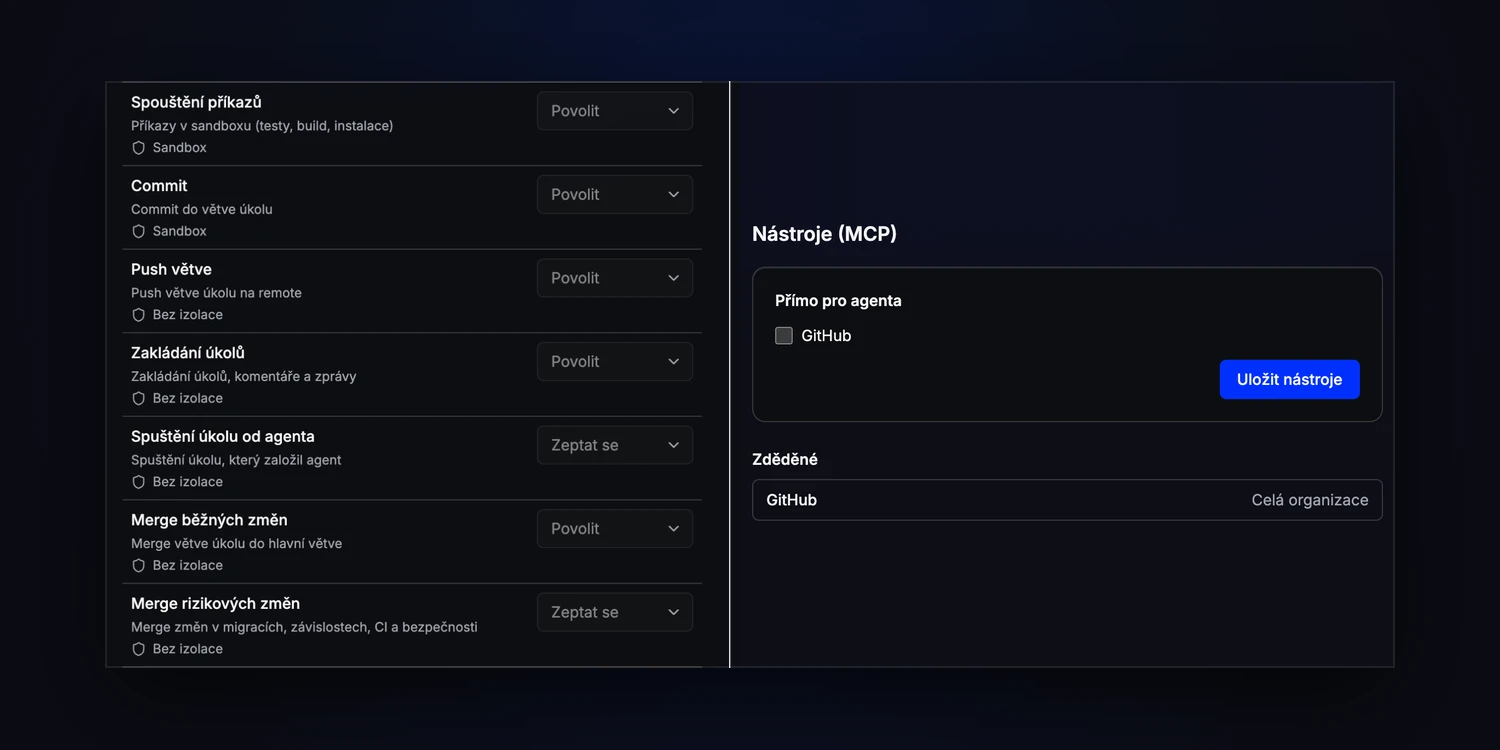
isolation in a sandbox or in a container with a firewall,
learning with approvals and a replay gate,
smart home in the same system,
automations: trigger (event, schedule, new pull request) → team or agent → action, with approval where needed.
OpenClaw comes closest: persistent agents side by side, teams and command approvals. However, its MCP servers are shared by all agents; per agent you can only allow or deny tools. Its sandbox can only cut off internet access entirely and has no domain allowlist. New skills can be set to require approval up front, but memory is saved without approval and learned changes aren't checked against past tasks.
Paperclip only approves actions that go through its own integrations; it doesn't approve commands or file edits. It does offer chat with agents, but always just one conversation, and only within a single company.
Cursor runs cloud agents' commands without approval; the only way to stop them is with hooks. In automations, it writes to memory without approval.
AURORA brings it together in one app: every agent has its own MCP servers, a runner checks every agent action (commands, files and connected services) against allow / ask / deny rules, the container has a firewall with a domain allowlist, and lessons only take effect after human approval and validation against past tasks.
Product comparison
Price | Works as a personal AI assistant? | Does the agent have its own persistent conversation? | Team with a lead | Does the agent ask before acting? | Is the agent isolated from the computer? | Does it learn, and who approves it? | Where it's controlled | Runs on a Claude subscription? | |
|---|---|---|---|---|---|---|---|---|---|
OpenClaw | free (open source), you pay only for the model | ✅ yes, a personal assistant in chat apps | ✅ yes, each agent has its own folder and personality description | ✅ yes, coordinator and specialists | ⚠️ partly, only for terminal commands (allow once / always / deny) | ⚠️ partly, a container or a remote machine over SSH; it can only cut off internet access entirely, no domain allowlist | ⚠️ partly, new skills can be approved up front, memory is saved on its own without approval, changes can be rolled back | web, terminal, chat apps | ✅ yes |
Hermes Agent | free (open source), you pay only for the model | ✅ yes, a personal agent in chat apps | ✅ yes, as profiles; helper agents only for a single task | ❌ no | ✅ yes, for terminal commands | ✅ runs in a container, internet access can be restricted | ✅ yes, learnings can require approval and changes can be rolled back | web, desktop app, terminal | ⚠️ partly, only with Max and paid usage beyond the limit |
Paperclip | free (open source), you pay only for the model | ❌ no, it runs a company of agents | ✅ yes, you can chat directly with each agent | ✅ yes, an org structure | ⚠️ partly, only for connected apps; doesn't approve commands or file edits | ✅ yes, via sandbox providers; internet access can be restricted with Kubernetes and Cilium or with Modal | ❌ only experimental memory so far, learning is planned | web | ✅ yes |
Claude Code | from approx. USD 20 per month, or pay-as-you-go | ⚠️ not really, it's a coding tool | ⚠️ partly, sessions can be resumed; every agent starts from scratch | ⚠️ partly, experimental and only for the duration of a session | ✅ yes, rules can be set for each tool | ⚠️ partly, only terminal commands; runs in the OS sandbox with a domain allowlist | ⚠️ partly, saves notes on its own, without approval | files and terminal | ✅ yes |
OpenAI Codex | limited free tier, full access from approx. USD 20 per month with ChatGPT, or pay-per-use API | ⚠️ not really, mainly a coding tool | ⚠️ partly, chats can be resumed; agents with roles start from scratch | ⚠️ partly, a main agent with role-based helper agents, only within a chat | ✅ yes, for commands, files and connected services | ✅ yes, a cloud container with a domain allowlist; locally the OS sandbox | ⚠️ partly, saves notes on its own, without approval | desktop app, terminal, IDE, web, iOS | ❌ no |
Letta Code | free (open source), optionally from approx. USD 20 per month | ⚠️ not really, a coding agent with memory | ✅ yes, a single agent that remembers | ❌ no, only helper agents | ✅ yes, details unknown | ❓ unknown | ⚠️ partly, saves learnings on its own; approval process unknown | terminal, web, desktop app | ❓ unknown |
Devin | from approx. USD 20 per month, enterprise pricing on request | ❌ no, a coding agent | ❌ no, every task is a separate session | ⚠️ partly, a session can start other sessions | ⚠️ partly, for connected services you can configure what needs approval | ✅ each session gets its own cloud machine | ✅ the agent proposes a new procedure, a human confirms it | web, Slack | ❌ no |
Beam AI | from approx. USD 50 per month, larger deployments on request | ❌ no, business processes | ✅ yes, agents for business processes | ✅ yes, an orchestrator agent | ✅ yes, for selected steps | ✅ in the cloud or on your own servers | ✅ proposes a change, tests it, a human approves it | web | ❌ no |
Conductor, Claude Squad, etc. | Claude Squad is free, Conductor doesn't list a price; you use your own Claude | ❌ no, manages coding sessions | ❌ no, every task is a separate session | ❌ no | ⚠️ partly, Conductor yes, Claude Squad no | ❌ no, each task only gets its own copy of the repository | ❌ no | desktop app, terminal | ✅ yes |
AURORA | free (personal project), you pay only for a Claude subscription | ✅ yes, one assistant above the teams, the vault and the smart home | ✅ yes, across projects; history and daily memory in the vault; conversations can be pinned | ✅ yes | ✅ yes, for every action (commands, files, connected services); each can be set to allow / ask / deny | ✅ yes, a sandbox with a domain allowlist, or a container whose firewall only lets through the sites it needs | ✅ proposes a lesson, checks it against past tasks, a human approves it | web and Telegram | ✅ yes |
As of 15 Nov 2026, based on each product's documentation and README. Prices are indicative and may change quickly. Beam information comes from the vendor's materials.Problems and solutions
Problems and solutions
While building AURORA, I tackled several specific problems. For each one, below is what bothered me and how AURORA solves it.
In Claude Code, an agent is just a file, not a persistent worker. Every run starts from scratch. In AURORA, an agent is a record with a role, a model, permissions and its own conversation. It picks up where it left off, even days later and from a different project.
Unchecked memory hurts the agent. An agent saves a new learning only once it's confirmed by tests, a review or the task being accepted. It's then checked against past tasks and I approve it. Automatic mode can be switched on, and a whole period can be rolled back.
OpenClaw was slow over the subscription. AURORA runs on my Claude subscription, not on the paid API, and responds within a few seconds; OpenClaw took around 15 s.
Multiple agents at once are hard to keep track of. Conversations can be pinned side by side like editors in VS Code, and I can step into the work at any time.
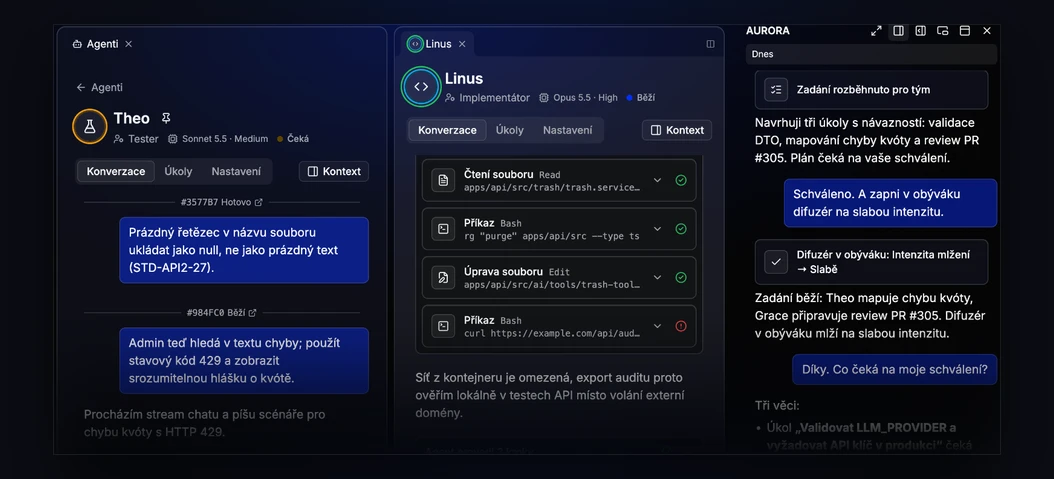
An agent can do damage through a mistake or injected content. It runs in a sandbox or in a container with a firewall, and a runner checks every action before execution against allow / ask / deny rules.
Knowledge from Claude Code gets lost. Claude Code and AURORA share a single memory via a plugin.
The assistant is needed beyond the Mac too. It works over the web from anywhere and via Telegram, including approvals.